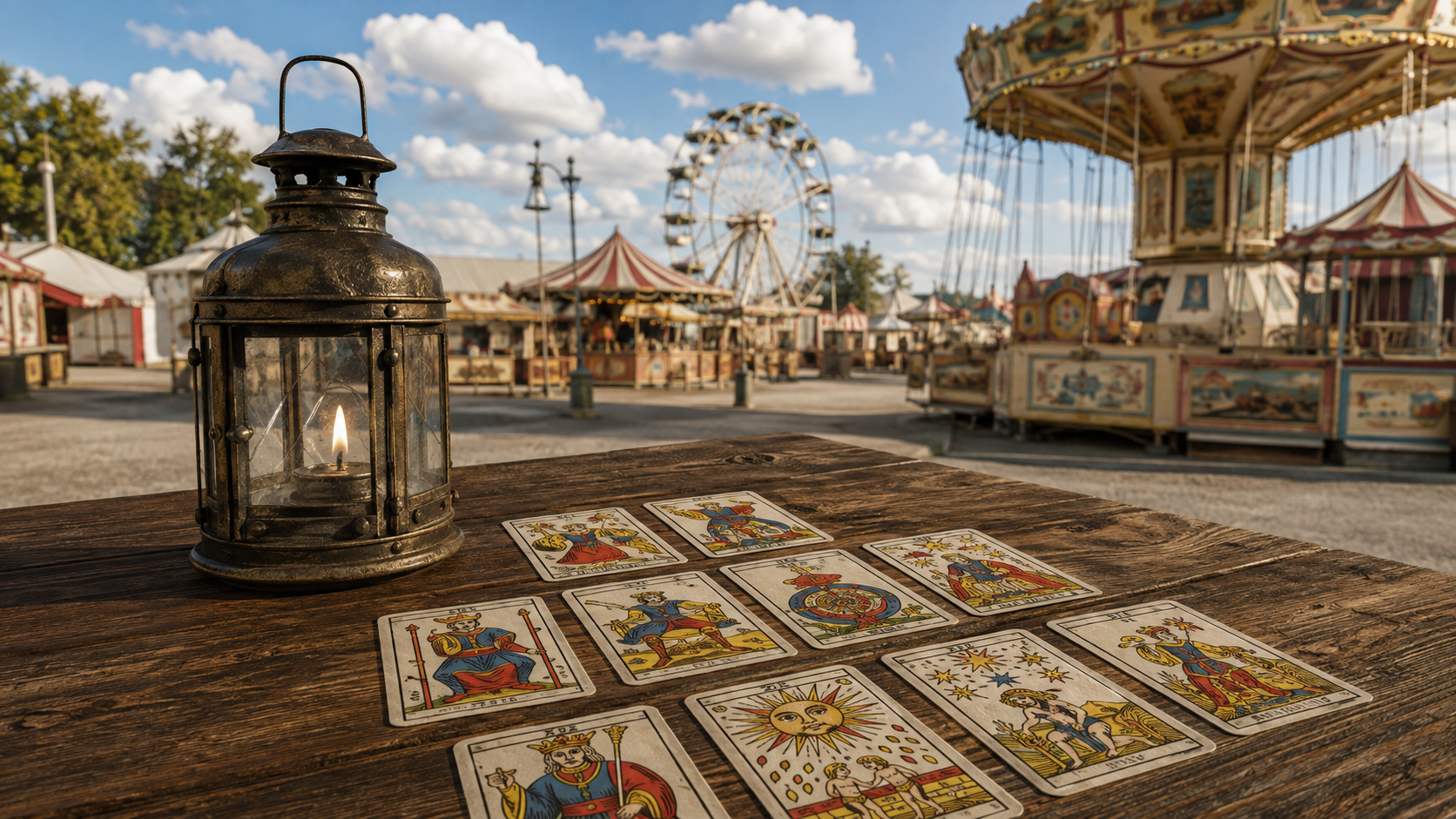
Dusty at the Table · The road starts here
Bring me the crossroads.
I’ll help you read the road.
Traditional divination for real situations – to examine the patterns, pressures, friction, choices and possibilities shaping what happens next.
No fixed destiny. No theatrical certainty. We look at the ground as it stands: what is gaining momentum, what is repeating, what is obscured, where the pressure lies, and where there may still be room to move.
The lantern is lit. Scroll to enter ↓
Halloween · The Turning Table
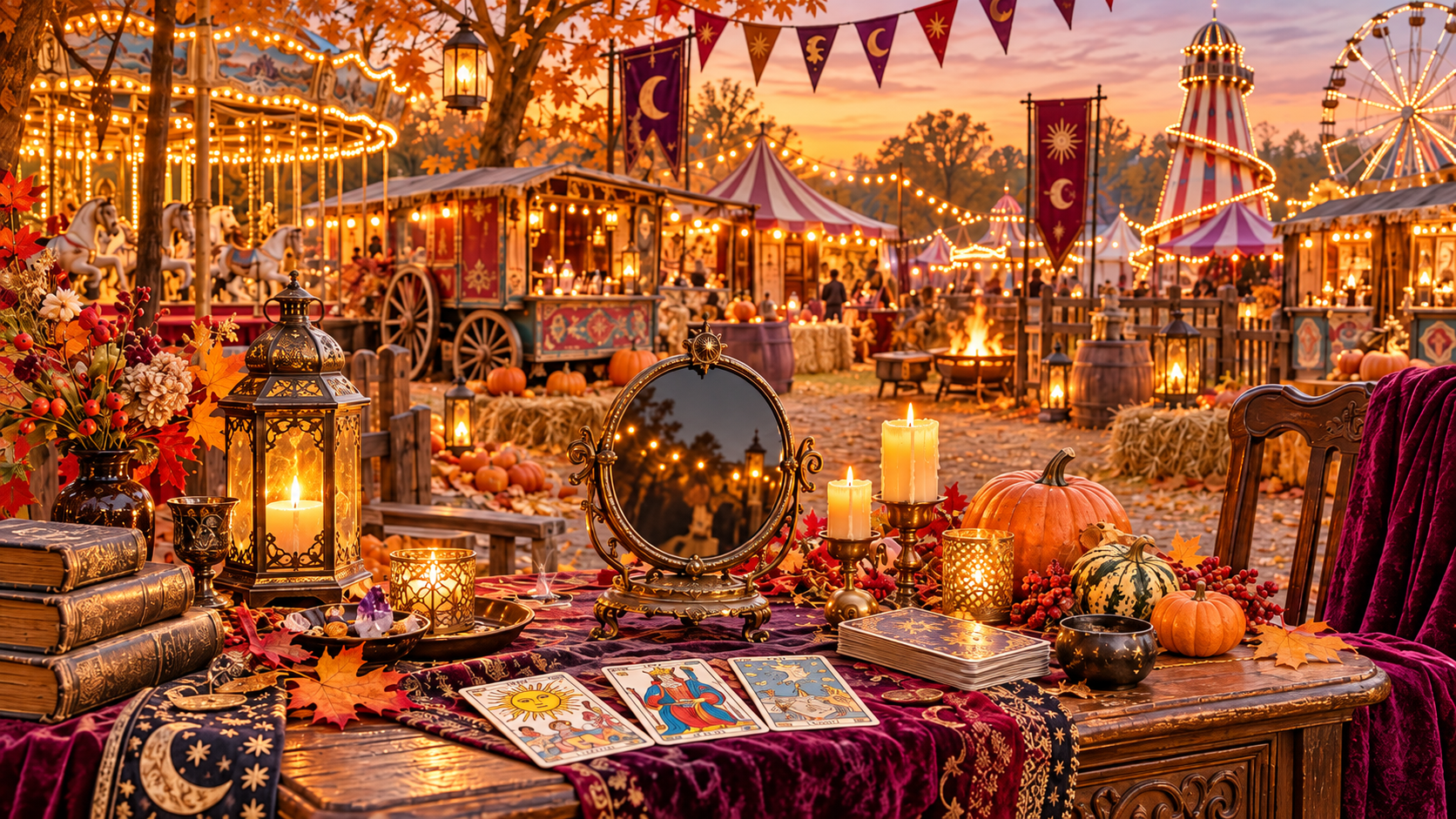
The Midway is open after dark.
Halloween has reached The Turning Table. For a short time only, The Ghost Light, The Black Mirror and The Witching Hour are waiting beyond the lights. Tarot, black mirror scrying and deeper seasonal readings for the questions that linger, the roads that feel unsettled and the things you cannot quite put down. The Midway is open for now. Step through before the season turns.
Enter the Halloween MidwayThree ways into the work
The situation comes first.
The Table, the Fairground and the Liminal Road are three different ways of looking at movement, pressure, repetition, uncertainty and choice.
The Table
Where the matter lands.
Bring the question, the decision, the relationship, the problem, the opportunity or the thing that will not quite leave you alone. We put it down in front of us and examine its structure: what is active, what is blocked, what is influencing it, what is repeating and what you may be able to do differently.
Go to The TableThe Fairground
Life has its rides.
The fairground gives the work a language that is vivid without pretending life is a fantasy. Ticket Booths are choices. Ghost Trains are recurring tracks. Dodgems are collisions. Halls of Mirrors are distorted perceptions. The Wall of Death is pressure, speed and risk. Sometimes the key question is simply whether to stay on the ride.
Enter the FairgroundThe Liminal Road
Where one thing becomes another.
Crossroads, thresholds, old paths, folklore, deserted places and stories that sit between explanation and mystery. This is where the work leaves the reading table and goes walking. It is also where Amelia Cross appears – usually when the road becomes quieter and the light starts to change.
Walk with AmeliaReadings
Find the reading that fits the road.
Different situations need different kinds of attention. A reading here is not treated as an announcement of a fixed future. It is a working map of the situation as it stands now: the momentum already present, the influences around it, the pressure points, the blind spots and the choices that may alter what happens next.
Tarot de Marseille is central to my work, but I do not force every question through exactly the same tool. The reading follows the matter. When another traditional method adds something useful, I use it.
The Ticket Booth
For the moment before you step in.
Something is being offered: a new direction, invitation, opportunity, relationship, move, project or decision. The Ticket Booth slows the moment down before momentum takes over.
- We look at: what is genuinely being offered and what may only look attractive from the entrance.
- We test: likely advantages, pressures, hidden costs and the first sensible move.
- Useful when: you are deciding whether to enter, wait, negotiate, decline or take a different route.
The aim is not to tell you which ticket to buy. It is to make the choice clearer.
Choose this readingThe Ghost Train
For the issue that keeps coming back.
The same argument wearing a different coat. The same kind of relationship. The same workplace problem. The same reaction. The same track, even when the scenery changes.
- We look at: the repeating structure beneath the latest version of the problem.
- We identify: triggers, habits, assumptions and pressures keeping the carriage on the same track.
- Useful when: you are tired of calling a pattern “fate” and want to know where an exit may actually exist.
A recurring pattern can feel inevitable. That does not make it destiny.
Choose this readingThe Wall of Death
For situations carrying speed, strain or too much pressure.
Some situations are not mysterious at all — they are overloaded. Too many moving parts, too little room, too much emotion, too much haste or one weak point being asked to carry everything.
- We look at: where the pressure is concentrated and what is making the situation unstable.
- We separate: genuine risk from anxiety, noise and worst-case imagination.
- Useful when: you need to know what requires a steady hand, what can wait and what should not be ignored.
This is a pressure map, not a disaster prediction.
Choose this readingThe Hall of Mirrors
For when reflection and reality no longer quite match.
Expectations, other people’s opinions, old roles and constant adaptation can alter the way we see ourselves. Eventually the reflection becomes more persuasive than the person standing in front of it.
- We look at: the roles you are carrying and whose expectations are shaping them.
- We examine: where perception may have become exaggerated, reduced or distorted.
- Useful when: you need to recover your own position before deciding what comes next.
The point is not to admire the reflection. It is to work out which part of it is true.
Choose this readingAt the Table · Worked Example
See the Table at Work.
What does a reading actually look like once the cards are on the wood? This short example uses two Tarot de Marseille cards to explore a familiar problem: plenty of effort, repeated job applications and very little movement.
“I’ve been applying for jobs but getting nowhere. Should I keep trying?”
Illustrative example only. The two cards are deliberately selected to demonstrate the reading method. This is not a real client consultation or a claimed random draw.
Reading the two cards together.
The Five of Batons puts effort and friction on the Table. Le Chariot brings direction, control and purposeful movement. Together they do not promise a job. They shift the question from “Am I trying hard enough?” to “Is the effort being organised in the most useful way?” That opens practical questions about targeting, presentation, training and strategy rather than pretending the cards can establish why an employer has said no.
At the Table
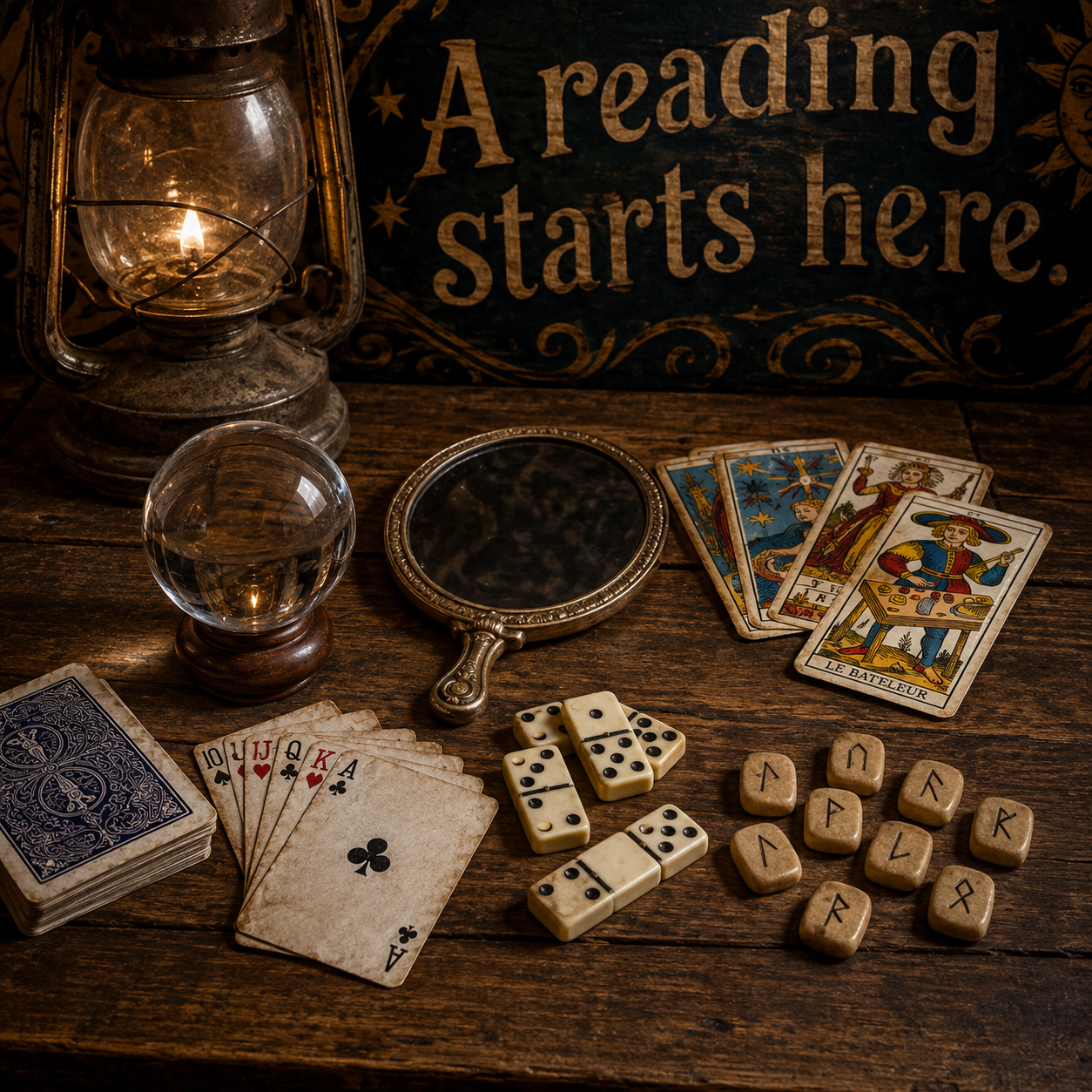
A reading starts here.
The situation first. The tools follow.
Tarot de Marseille is usually the backbone of the reading. I value it because the old images leave room for thought: they are direct, structural and less interested in handing you a ready-made story. They make us look closely at position, movement, tension, relationship and sequence.
But the Table is larger than one deck. Depending on the matter, I may work with ordinary playing cards, dominoes, the crystal ball, a black scrying mirror, runes or another traditional system. I do not throw everything onto the table for effect. A tool earns its place by helping us see something more clearly.
The work is interpretive rather than fatalistic. A spread may show momentum, pressure, habit, likely consequences or an emerging direction. None of those things requires the future to be fixed. Circumstances change. People change their minds. New information arrives. A useful reading has to leave room for that reality.
The working principle
Grit. Graft. Open Road.
Grit
The truth has texture.
Useful readings do not sand away the awkward parts. Contradiction, resistance, disappointment, uncertainty and uncomfortable detail often contain the information that matters most.
Graft
The work is in the reading.
Years of practice, observation, comparison, study and judgement matter more than performance. The craft is not in making everything sound mysterious. It is in knowing what deserves attention and what is merely noise.
Open Road
Clarity should lead somewhere.
A reading should leave you with a better map than the one you arrived with: what is moving, what is blocked, what can be influenced, what may need accepting, and where another route remains possible.
The Fairground
This ground is personal.
It was part of my life before it became part of the work.
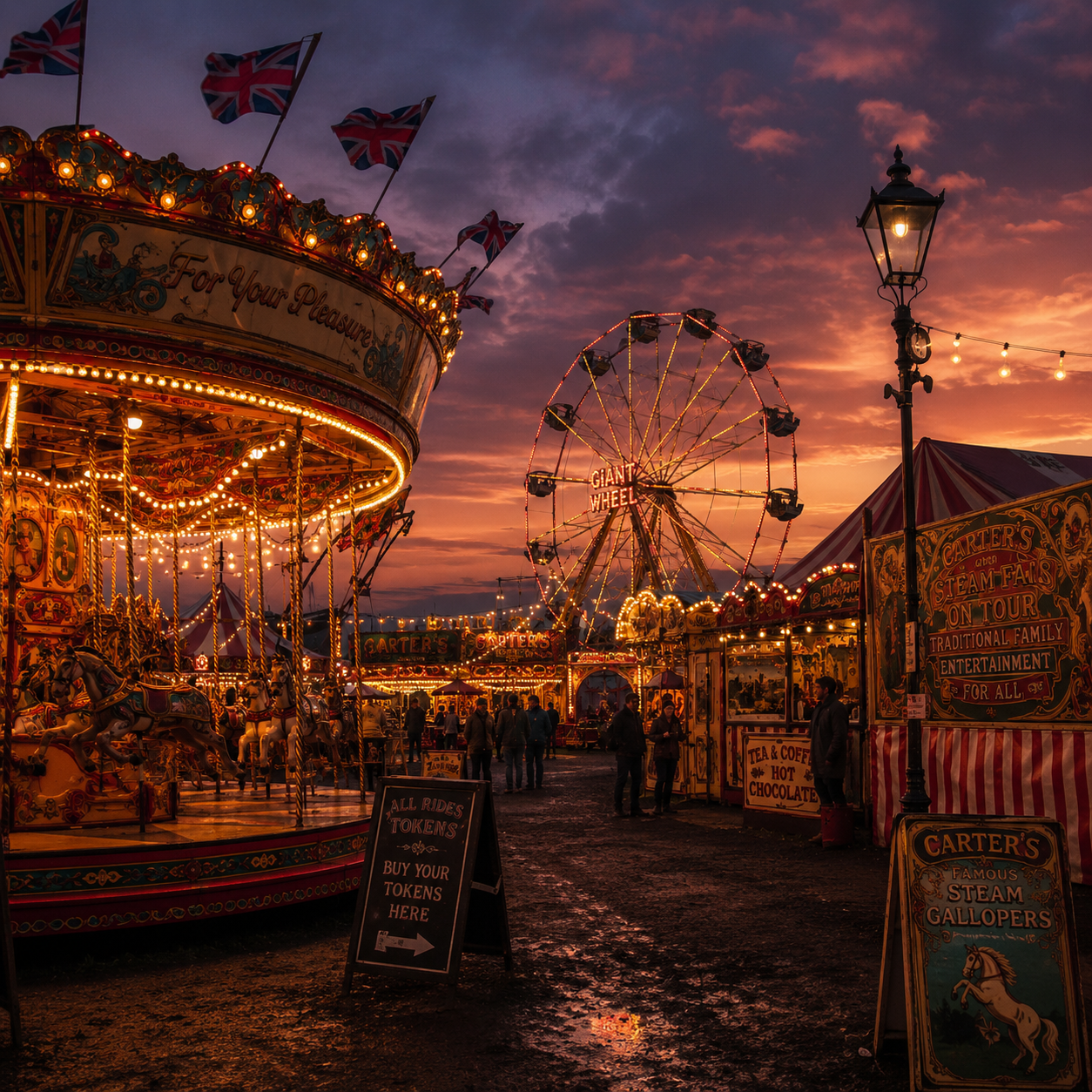
Long before the Ticket Booth, Ghost Train or Hall of Mirrors became names for readings, the travelling fair was already part of my world. My father had two stalls selling fancy goods and toys, and some of my early life was spent going to fairs and fetes, seeing familiar faces reappear on different grounds and getting to know something of the travelling community around them.
It was a world with its own rhythm: canvas, timber, bulbs, music, trailers, stalls being opened, rides waking up, the ground changing character when the lights came on. Then, after the crowds, the same place could become strangely still. That contrast stayed with me – spectacle and silence, movement and waiting, entrance and exit.
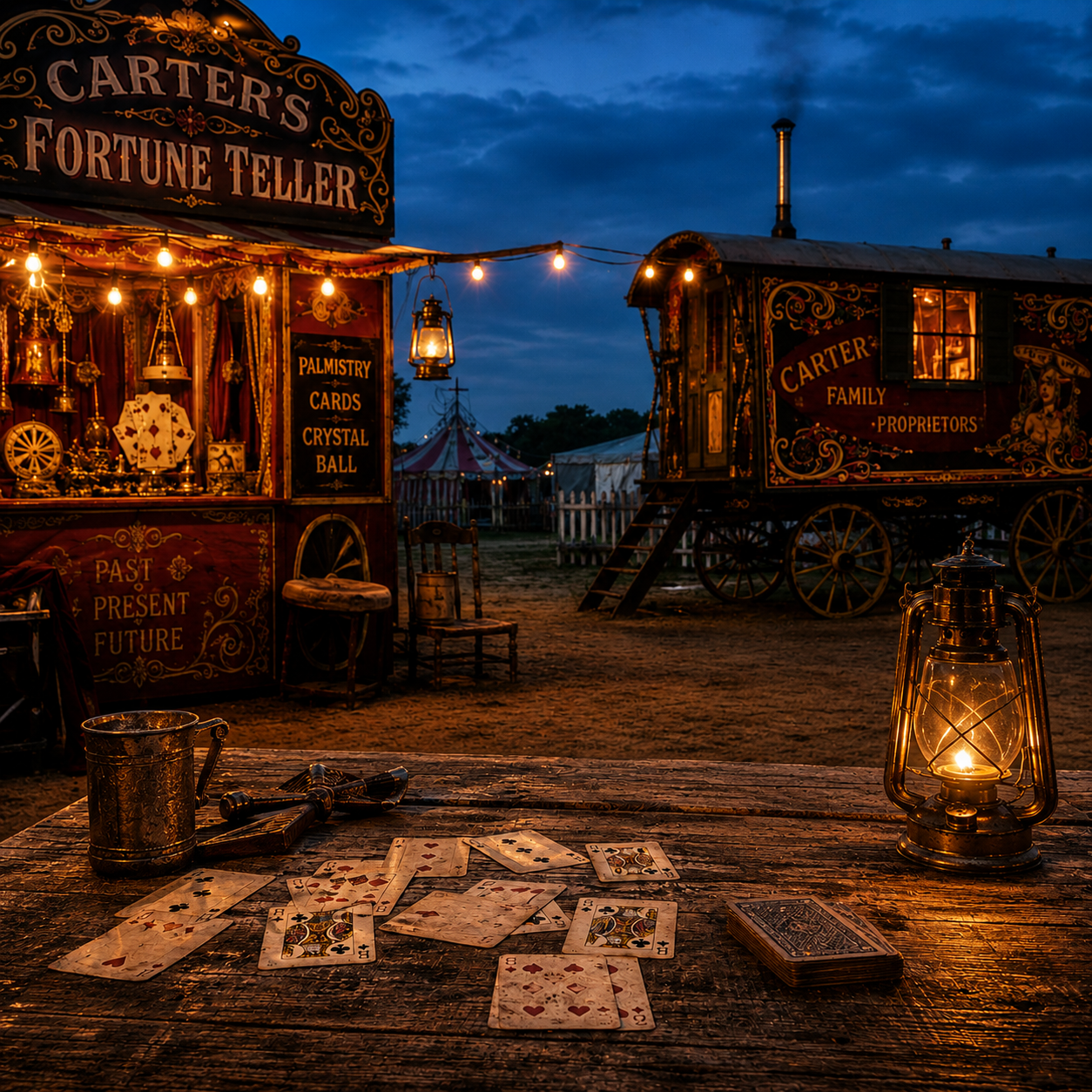
I also met Romani Gypsies through that fairground world. They were not characters in a story or an aesthetic added later. They were people I knew. I was taught reading practices by Romani Gypsies I met through those travelling circles, including the use of playing cards, and I was introduced to other traditional forms of divination such as tarot, palmistry and the crystal ball.
That is why the fairground remains here. It is not branding pasted over the work. It is part of the road that led to it. And as a language for ordinary life it still works: some things invite you in, some spin you round, some collide with you, some distort what you see, and some keep you on the same track until you notice the exit sign.
The Liminal Road
Walk With Amelia.
When the Table ends, the road continues – into folklore, thresholds, deserted places and the stories that become louder when everything else goes quiet.
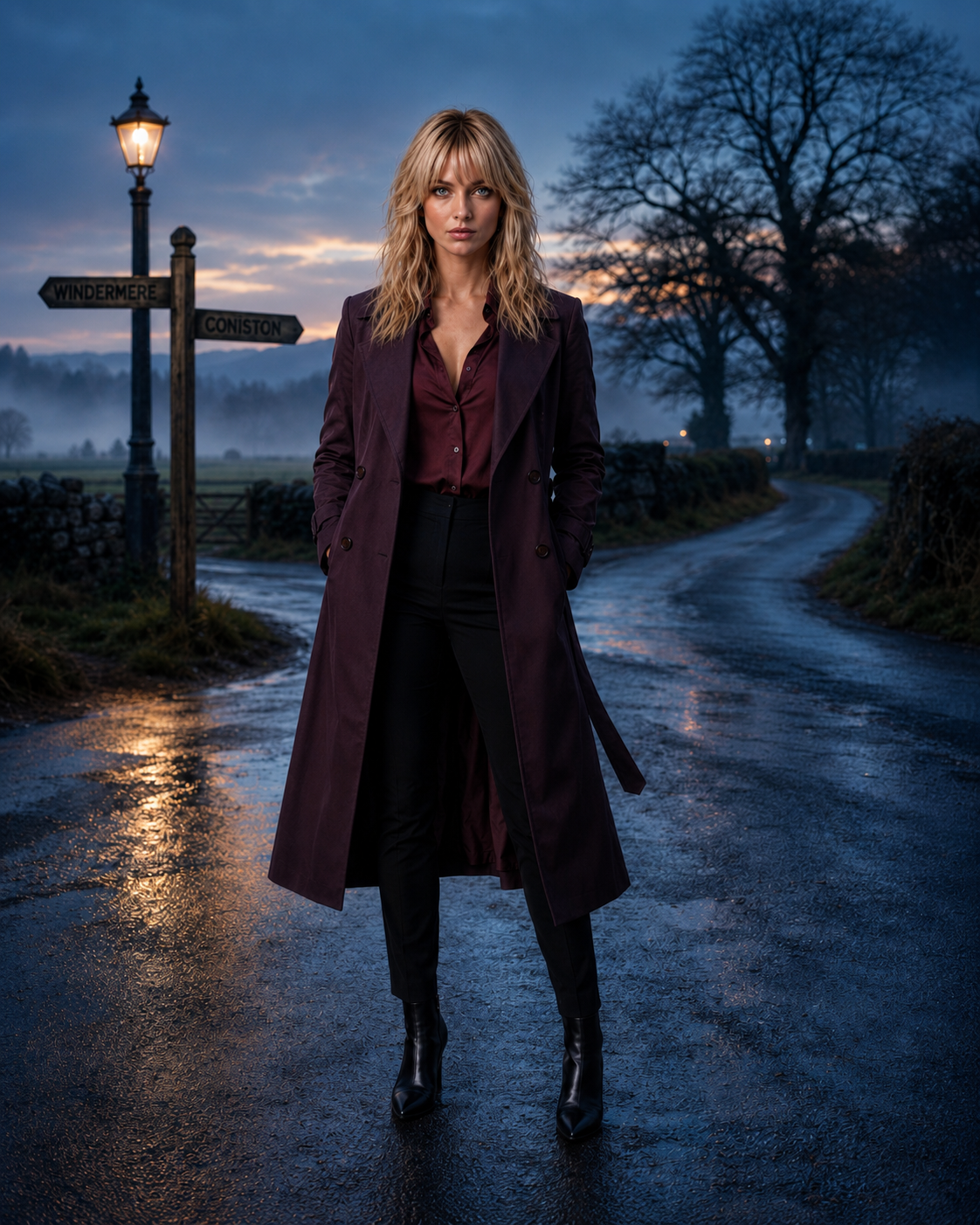
Amelia is the guide who takes the work out into the landscape. She walks the places that sit between categories: crossroads at dusk, old paths, churchyards, coast roads, forgotten corners, fairgrounds after closing and ordinary locations that feel different once the crowd has gone and the lights are thinning out.
Her territory is folklore, local legend, superstition, strange encounters and liminal space. A banshee story may lead into the history of a belief. A mirror superstition may tell us more about people than ghosts. An abandoned midway after midnight may become a way of talking about fear, memory, repetition or the peculiar atmosphere of places built for noise once they fall silent.
Amelia is curious, but she does not have to call every unexplained thing paranormal. She can leave a story unresolved. Sometimes there is a historical explanation. Sometimes there is a psychological one. Sometimes there is only testimony, atmosphere and the fact that somebody experienced something they could not comfortably place.
Then there is Amelia After Midnight: the fairground after the gates have closed, the Ferris wheel standing against the dark, a bulb still burning where nobody is supposed to be, a footstep behind the ticket booth, an old story resurfacing at exactly the wrong hour. The mystery is allowed to breathe – but reality is never abandoned to make it more exciting.
“Walk with me.” – Amelia
About Dusty
From the Fairground to the Table.
The road came first. The craft was handed on. The professional framework came later.
Most people simply call me Dusty. I began reading cards at about nine years old, in a world where the travelling fair was not a decorative idea but part of ordinary life. My father worked the grounds with his stalls, and through that travelling fraternity I grew up around people who understood that a reading was not a party trick. It was a craft.
My first lessons did not come from a manual. They came person to person. Romani practitioners and travellers known through those fairground circles taught me to read playing cards and introduced me to forms of traditional divination including tarot, palmistry and the crystal ball. What mattered was not memorising a paragraph for each card. It was learning to watch the whole spread, the person, the question, the atmosphere and the way one sign altered another.
I did not learn the craft by picking up a handful of books, completing a short online course or collecting meanings from videos. Those things can be useful introductions, but an introduction is not the same as a developed practice. My foundation came through direct teaching from people who already knew the work, whatever natural aptitude I brought to it, and then many years of practice, study, correction and refinement. Like any serious skill, reading becomes more reliable through use, feedback and judgement accumulated over time.
That distinction still matters to me. In Romani traditions, and in many other folk and cultural traditions of divination, the act of reading can carry real gravity. Questions are brought because something matters. The work is treated with respect because knowledge has been carried through families, communities and generations. Much of that tradecraft was oral and practical: shown, corrected and understood through use rather than reduced to a published formula. Some of what I was taught in that way is not material I have ever found reproduced in a book.
I was curious far beyond the cards. Divination led into questions about consciousness, spirits, folklore, religion, the supernatural and the occult. Over the years I sought out teachers, practitioners, researchers and traditions that could add another piece to the puzzle. Books and archives became part of that search, but they were never the whole of it. Some knowledge is academic. Some is practical. Some is esoteric: taught privately, demonstrated rather than published, and understood properly only through context and experience. I do not treat that as a badge of status. It simply explains why parts of my working method cannot be reduced to a list of textbook meanings or a downloadable formula.
Professionally, I later added a grounded framework around that older craft, including training to Master Practitioner level in NLP, Time Line Therapy, hypnotherapy and counselling-related work. Those disciplines are not offered here as therapy. They sit behind the Table as an additional framework for language, patterns, behaviour, context and responsible conversation.
I am also a trained psychic and spirit medium. That remains part of my background, but mediumship is not a standard service at Dusty at the Table at present. The decision is deliberate. My current work is concentrated on the living person sitting at the crossroads now: the relationship, choice, pressure, repeating pattern, loss of direction or practical problem that still has to be navigated in this life. Mediumship has its own purpose and sensitivity; this Table is presently devoted to helping people read the road they are still walking.
After all these years, Tarot de Marseille remains at the centre because it demands something from the reader. It does not hand over a complete illustrated story or tell you, scene by scene, what you are supposed to think. The reader has to create the meaning from the board: structure, number, suit, proportion, direction, repetition, proximity, visual tension, interaction and the exact question being asked. That requires creativity, but not free invention. The imagination has to be disciplined by the cards and by the situation in front of you.
Some tarot systems provide stronger pictorial cues and more readily taught narrative meanings. The Marseille gives less away. That is precisely why I value it. It makes the reader do more of the interpretive work rather than leaning on a pre-written script. A competent reading therefore depends less on reciting what a card is supposed to mean and more on seeing how meaning changes when the cards meet each other on the table.
That distinction is central to my approach. Knowing a list of card meanings is useful; it is not the same thing as knowing how to read. Reading well asks for pattern recognition, judgement, contextual sensitivity, imagination, restraint and the ability to communicate what you see without turning uncertainty into false certainty. Those abilities take time to develop.
Other tools remain available – playing cards, dominoes, runes, crystal work, scrying and oracle systems – but nothing is put on the Table merely to make it look mysterious.
The mystery is real enough without embellishment. My job is to keep one hand on that mystery and the other firmly on the road.
A craft, not a script.
Books, courses and videos can teach vocabulary. They can introduce a system and give someone a place to begin. But fluency is something else. My own craft was built through direct teaching, long practice, study, natural aptitude developed through use, and years of learning how to judge a living spread rather than repeat a canned definition. That is the difference I bring to the Table: no fluff, no performance and no borrowed certainty – just the work of reading the matter properly.
“I lived it. I was taught it. I studied it. I still test it against the road.”
The Table is the meeting point.
Fairground experience, traditional transmission, natural aptitude developed through practice, long study, esoteric teaching and modern communication skills all meet here. The method has roots, but the question belongs to the present – and the reading has to earn its value in the real situation.
The Trinity of the Work
Grit. Graft. The Road.
The unvarnished truth.
Grit is the friction: the part of the situation that resists the easy answer. It is what gives the reading traction. If something is awkward, contradictory or unstable, polishing it away would make the map less useful.
The focused labour of discernment.
Graft is the work at the Table: attention, pattern recognition, context, judgement and the labour of turning cards and information into something coherent enough to use.
The way ahead — and your grip on it.
The Road is what remains when the reading is finished: a clearer sense of what is moving, what is blocked, what deserves caution and where your own decisions still matter.
The Turning Table
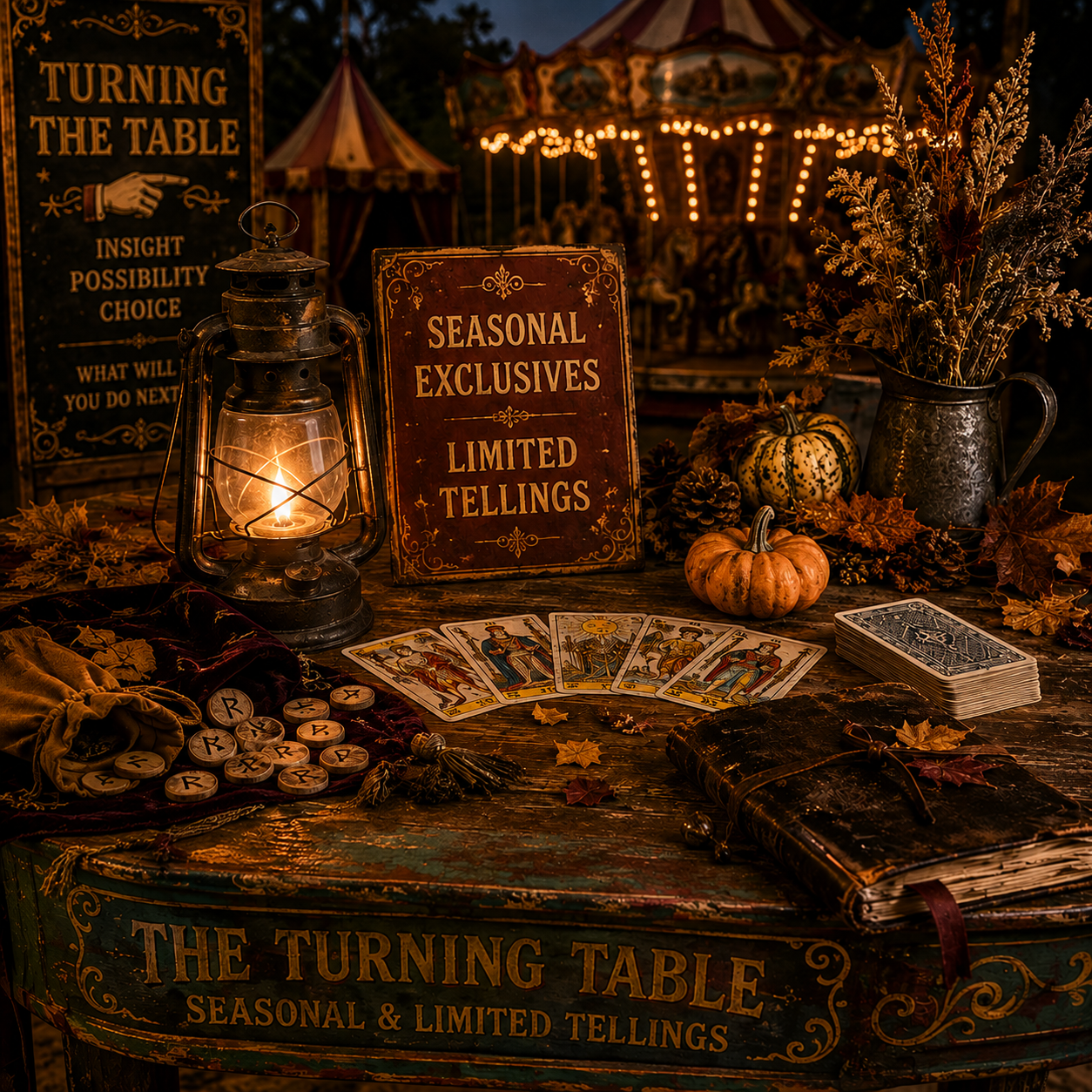
Seasonal and limited tellings.
Some readings belong to a particular point in the year – a threshold rather than a permanent fixture.
The Turning Table is where temporary and seasonal work appears: readings shaped around the turning points of the calendar, the change of season and those moments when people naturally take stock of what is ending, what is beginning and what needs carrying forward.
Solstice, Equinox, Samhain, Yule, Easter and other seasonal thresholds may all bring their own limited reading or piece of work. The imagery can be old, but the question remains practical: what has changed, what has reached its limit, what is beginning to move and what deserves attention now?
These readings appear when they have a reason to be on the Table and disappear when that moment has passed. The point is not to manufacture urgency. It is to let the calendar give a particular reading its proper setting.
The Table turns. The offer changes.
Book
The lantern is lit. Bring the matter to the Table.
You do not need to arrive with the perfect question, and you do not need to believe that every event has already been written. Bring the situation as it is: the decision, the pressure, the repeating pattern, the relationship, the uncertainty or the road you are trying to read.
Choose the reading that most closely fits the matter, then follow the booking instructions for the format, information required and next steps. If the situation does not fit neatly into one title, the reading can still begin with the situation rather than forcing the situation into a label.
By using the site, products or services and by making a booking, you agree to the applicable terms, policies and booking conditions. Errors and omissions excepted.